TWO:The Government now resolved to follow up the vigorous step they had so tardily taken, by the prosecution of O'Connell and several leading members of the Association. They were arrested in Dublin on the 14th of October, charged with conspiracy, sedition, and unlawful assembly. The other gentlemen included in the prosecution were Mr. John O'Connell, Mr. Thomas Steele, Mr. Ray, Secretary to the Repeal Association, Dr. Gray, proprietor of the Freeman's Journal, Mr. Charles Gavan Duffy, editor of the Nation, Mr. Barrett, of the Pilot, and the Rev. Messrs. Tyrrell and Tierney, Roman Catholic priests. Mr. O'Connell, with his two sons and several friends, immediately on his arrest, went to the house of Mr. Justice Burton, and entered into recognisances, himself in ¡ê1,000, with two sureties of ¡ê500 each. The tone of Mr. O'Connell was now suddenly changed. From being inflammatory, warlike, and defiant, it became intensely pacific, and he used his utmost efforts to calm the minds of the people, to lay the storm he had raised, and to soothe the feelings he had irritated by angry denunciations of the "Saxon." That obnoxious word was now laid aside, being, at his request, struck out of the Repeal vocabulary, because it gave offence. Real conciliation was now the order of the day.
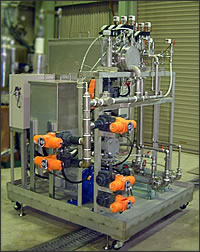
A hydrocyclone (liquid cyclone) injects treatment solution into stationary equipment to perform separation, classification, and concentration, and is an innovative separator with a very simple structure and no drive unit.
Structure of a hydrocyclone (liquid cyclone)
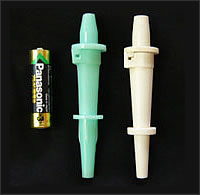
A suspension containing fine particles of several micrometers or more is supplied to a cylindrical container circumferentially at high speed. And as a result it starts to rotate and a centrifugal force is generated. At this time a gravitational acceleration of several tens of thousands of G is generated in the circumferential direction, and thus leading to fast sedimentation and concentration of the fine particles. The separated concentration can be freely selected by changing the supply rate (supply pressure and flow rate) and the flow ratio of the outlet. Our hydrocyclone (liquid cyclone) was designed and manufactured to classify and concentrate fine particles, and so has a small element.
THREE:The very Dames des Halles, the market women, took up the word against them. They sang a song with much vivacity, "Donnez-nous notre paire de gants,"¡ªequivalent in pronunciation to notre p¨¨re de Ghent, that is, Louis, who was then residing at Ghent. None but the very lowest of the population retained the old illusions respecting him. In such circumstances, not even his new Constitution could satisfy anybody. It was very much the same as Louis XVIII. had sworn to in 1814. It granted free election of the House of Representatives, which was to be renewed every five years; the members were to be paid; land and other taxes were to be voted once a year; ministers were to be responsible; juries, right of petition, freedom of worship, inviolability of property, were all established. But Buonaparte destroyed the value of these concessions by publishing this, not as[93] a new Constitution, but as "an additional Act" to his former Constitution. The word "additional" meant everything, for it proclaimed that all the despotic decrees preceding this fresh declaration were still in force, and thus it neutralised or reduced these concessions to a mere burlesque.
- Equipment costs can be reduced.
- Operating costs can be reduced.
- Maintenance costs can be reduced.
- Any change in raw material and product can be easily addressed.
- Large amounts can be treated in a small area.
- Separation and cleaning are easy because of the simple structure.
- Simplified control
- This equipment can be operated in synchronization with external devices.
- Alarm and interlock mechanism.
THREE:The movement going forward in the Established Church of Scotland during this reign related almost exclusively to the subject of patronage. This church, though drawing its origin from Switzerland, a thoroughly Republican country, and rejecting bishops, took good care to vest the right of presenting ministers to parishes in the clergy. The Government insisted on this right continuing in lay patrons; but for some time after the Revolution the people asserted their right to choose their own pastors, and continued to carry it. But in 1698 the General Assembly took the opportunity, when it had been accused by the English Church of throwing the office of choosing ministers amongst the people, to repudiate all such notion on their part. They declared unanimously that "they allowed no power in the people, but only in the pastors of the Church, to appoint and ordain to such offices."
- Classification and concentration for the manufacture of inorganic powder materials
- Classification of ceramic materials
- Removal of fine particles, including iron powder
- Removal of fine particles from pigments
- Removal of fine organic particles from solvents
- Separation of starch and yeast
- Removal of fine particles from high-temperature strong acid solutions
- Removal of fine particles from low-temperature solutions